
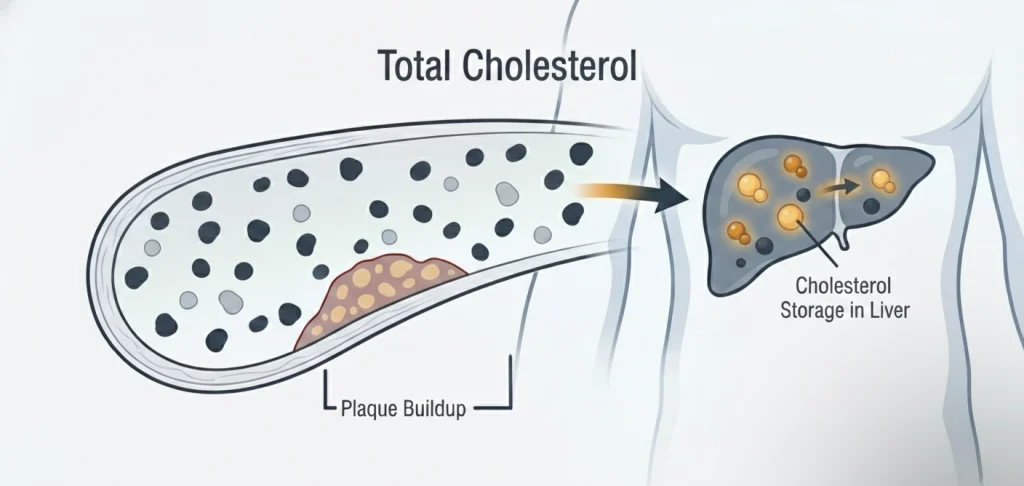
Total Cholesterol: Why Your Doctor’s “Normal” Might Be Sabotaging Your Health
Total cholesterol is one of the most misunderstood biomarkers in medicine. For decades, it’s been vilified as the primary predictor of heart disease, leading to aggressive statin prescribing and low-fat diet recommendations that often do more harm than good. The truth is far more nuanced: total cholesterol by itself tells you almost nothing about cardiovascular risk, metabolic health, or longevity.
Your doctor sees total cholesterol at 220 mg/dL and immediately reaches for the prescription pad. But without understanding HDL, LDL particle size, triglycerides, inflammation, and insulin sensitivity, that number is essentially meaningless. You could have total cholesterol at 250 mg/dL and be metabolically healthy, or 180 mg/dL and be heading toward a heart attack. Context is everything, and total cholesterol provides almost none.
What Is Total Cholesterol?
Total cholesterol is exactly what it sounds like: the sum of all cholesterol carried in your bloodstream. It’s calculated by adding together LDL cholesterol (low-density lipoprotein), HDL cholesterol (high-density lipoprotein), and VLDL cholesterol (very low-density lipoprotein, which carries triglycerides).
The formula is simple: Total Cholesterol = LDL + HDL + (Triglycerides ÷ 5)
Cholesterol itself isn’t the villain it’s been made out to be. It’s an essential molecule required for cell membrane structure, hormone production (testosterone, estrogen, progesterone, cortisol), vitamin D synthesis, bile acid production for fat digestion, and brain function and neurotransmitter activity. Without adequate cholesterol, these critical processes fail.
The problem isn’t cholesterol itself—it’s oxidized cholesterol, inflammatory processes that damage blood vessels, insulin resistance and metabolic dysfunction, and the balance between different cholesterol fractions. Total cholesterol tells you none of this.
Why Total Cholesterol Matters (And Why It Doesn’t)
Here’s the uncomfortable truth: total cholesterol is a weak predictor of cardiovascular disease on its own. Studies consistently show that roughly half of people who have heart attacks have “normal” total cholesterol. Conversely, many people with elevated total cholesterol live long, healthy lives without cardiovascular events.
So why does it matter at all? Total cholesterol provides a starting point for deeper investigation. Extremely high total cholesterol (above 300 mg/dL) may indicate familial hypercholesterolemia or other lipid disorders requiring intervention. Very low total cholesterol (below 150 mg/dL) can indicate malnutrition, liver disease, hyperthyroidism, or other metabolic problems.
But for most people falling somewhere in the middle, total cholesterol is essentially useless without context from other markers. What actually matters for cardiovascular risk and metabolic health is the composition of that total cholesterol—how much is HDL (protective), what type of LDL particles you have (small dense vs. large fluffy), your triglyceride levels (indicating metabolic health), your inflammatory status (hs-CRP, oxidized LDL), and your insulin sensitivity and metabolic markers.
A high total cholesterol driven by very high HDL is completely different from high total cholesterol driven by high triglycerides and small, dense LDL particles. The former is often protective. The latter is dangerous. But total cholesterol alone doesn’t distinguish between these scenarios.
Normal vs. Optimal Total Cholesterol Levels
Here’s where conventional medicine creates confusion.
Standard Reference Ranges:
- Desirable: Below 200 mg/dL
- Borderline high: 200-239 mg/dL
- High: 240 mg/dL and above
The Problem With “Normal”:
These ranges were established based on population averages and the assumption that lower total cholesterol is always better (which research has repeatedly disproven). They don’t account for HDL levels, LDL particle composition, triglycerides, inflammation, age, sex, or metabolic health.
A 45-year-old man with total cholesterol of 230 mg/dL might be told he’s “borderline high” and needs medication. But if his HDL is 80 mg/dL, his triglycerides are 60 mg/dL, his LDL particles are large and fluffy, and his inflammation is low, he’s likely at very low cardiovascular risk. Meanwhile, someone with total cholesterol of 180 mg/dL, low HDL at 35 mg/dL, high triglycerides at 200 mg/dL, and insulin resistance is at dramatically higher risk—but might be told they’re “fine.”
This is the fundamental flaw with using total cholesterol as a primary health metric.
Optimal Range for Performance and Longevity:
There is no single optimal total cholesterol number because it depends entirely on the composition. However, general guidelines for metabolically healthy individuals include total cholesterol between 180-220 mg/dL with favorable HDL (above 60 mg/dL for men, above 70 mg/dL for women), low triglycerides (below 100 mg/dL), large LDL particles rather than small dense particles, and low inflammation (hs-CRP below 1.0 mg/L).
Some of the healthiest, longest-lived populations have total cholesterol in the 180-220 mg/dL range with excellent HDL and low triglycerides. Others with similar total cholesterol but poor HDL, high triglycerides, and insulin resistance have terrible health outcomes.
Context is everything.
What Causes High Total Cholesterol?
Multiple factors influence total cholesterol, and not all of them are problematic.
Genetics play a significant role. Familial hypercholesterolemia is a genetic condition causing very high LDL and total cholesterol from birth, significantly increasing cardiovascular risk and requiring aggressive management. More commonly, genetic variations affect how efficiently your body produces, processes, and clears cholesterol, leading to naturally higher or lower levels without necessarily indicating disease.
Diet affects total cholesterol, but not in the way most people think. Dietary cholesterol (from eggs, shellfish, etc.) has minimal impact on blood cholesterol for most people—your liver regulates production based on intake. Saturated fat intake can raise LDL cholesterol in some individuals (but often increases large, fluffy LDL rather than small, dense particles). Trans fats and oxidized oils from processed foods dramatically worsen cholesterol profiles. Excess refined carbohydrates and sugar increase triglycerides and small, dense LDL particles while lowering HDL—often worsening your cholesterol profile despite not being “cholesterol” in the diet.
Metabolic health is often the primary driver. Insulin resistance causes the liver to overproduce triglycerides and VLDL, altering cholesterol metabolism. Obesity, particularly visceral fat, disrupts normal cholesterol regulation and promotes inflammatory, atherogenic particles. Type 2 diabetes typically produces a terrible lipid profile (high triglycerides, low HDL, small dense LDL) even when total cholesterol isn’t dramatically elevated.
Thyroid function significantly affects cholesterol metabolism. Hypothyroidism slows cholesterol clearance from the bloodstream, often elevating total cholesterol and LDL substantially. Treating thyroid dysfunction often normalizes cholesterol without additional intervention.
Stress elevates cortisol, which increases cholesterol production as the body produces stress hormones that require cholesterol as a precursor.
Age and hormones influence cholesterol. Total cholesterol naturally increases with age, particularly in women after menopause when protective estrogen declines. Low testosterone in men is associated with worse cholesterol profiles.
Certain medications including corticosteroids, beta-blockers, some diuretics, and immunosuppressants can elevate total cholesterol.
What Causes Low Total Cholesterol?
While high cholesterol gets all the attention, very low total cholesterol (below 150 mg/dL) can indicate problems.
Malnutrition or malabsorption prevents adequate cholesterol production and absorption. Liver disease impairs the liver’s ability to produce cholesterol. Hyperthyroidism accelerates cholesterol metabolism and clearance. Chronic inflammation or critical illness depletes cholesterol rapidly. Certain medications including statins (intentionally) and some other drugs can lower cholesterol excessively.
Research shows that very low total cholesterol (below 160 mg/dL) is associated with increased all-cause mortality in some populations, particularly elderly individuals. This isn’t because low cholesterol causes death, but because serious illness often depletes cholesterol. However, it’s a signal worth investigating rather than celebrating.
The Cholesterol Fractions That Actually Matter
Instead of obsessing over total cholesterol, focus on these components:
HDL cholesterol (high-density lipoprotein) is the “good” cholesterol that removes excess cholesterol from tissues and arteries, returning it to the liver for disposal. Higher HDL is consistently associated with lower cardiovascular risk. Optimal HDL is above 60 mg/dL for men and above 70 mg/dL for women. Low HDL (below 40 mg/dL for men, below 50 mg/dL for women) dramatically increases cardiovascular risk regardless of total cholesterol.
LDL cholesterol (low-density lipoprotein) is the “bad” cholesterol that delivers cholesterol to tissues. But even this is oversimplified—LDL particle size and number matter far more than total LDL cholesterol. Large, fluffy LDL particles are relatively benign and may even be protective. Small, dense LDL particles are highly atherogenic and dangerous. You can have “normal” LDL cholesterol but if most particles are small and dense, cardiovascular risk is high.
Triglycerides indicate metabolic health and insulin sensitivity. High triglycerides (above 150 mg/dL) suggest insulin resistance, metabolic dysfunction, and increased cardiovascular risk. Low triglycerides (below 100 mg/dL, ideally below 70 mg/dL) indicate good metabolic health and insulin sensitivity.
The triglyceride-to-HDL ratio is one of the best predictors of insulin resistance and cardiovascular risk. Calculate by dividing triglycerides by HDL (both in mg/dL). A ratio below 2 is optimal, ratios above 3 suggest insulin resistance, and ratios above 5 indicate severe metabolic dysfunction.
These markers together tell the story total cholesterol cannot.
How to Optimize Your Cholesterol Profile
Forget about obsessively lowering total cholesterol. Instead, focus on optimizing the cholesterol fractions and addressing metabolic health.
Improve insulin sensitivity and metabolic health through reduced refined carbohydrate and sugar intake (often more impactful than reducing dietary fat), regular exercise including both resistance training and cardiovascular activity, weight loss if overweight, particularly reduction of visceral fat, adequate sleep (7-9 hours nightly), and stress management.
Increase HDL cholesterol through regular exercise (particularly high-intensity interval training and resistance training), moderate alcohol consumption (if you drink—1-2 drinks daily can raise HDL, though abstaining is fine too), healthy fats from olive oil, avocados, nuts, and fatty fish, omega-3 fatty acids from fish or supplementation, and avoiding trans fats and excessive processed foods.
Reduce small, dense LDL particles by lowering triglycerides through carbohydrate reduction, increasing omega-3 intake from fatty fish or quality supplements, avoiding trans fats and oxidized oils from processed foods, and improving insulin sensitivity (the most effective intervention).
Reduce inflammation with an anti-inflammatory diet emphasizing whole foods, vegetables, berries, and omega-3s, regular exercise without overtraining, quality sleep, stress management, and maintaining healthy body composition.
Address underlying conditions including treating hypothyroidism if present, optimizing hormone levels (testosterone, estrogen) when appropriate, and managing insulin resistance or diabetes aggressively.
Total Cholesterol and Metabolic Optimization
When metabolic dysfunction is driving unfavorable cholesterol profiles—high triglycerides, low HDL, small dense LDL particles—targeted interventions can provide support alongside lifestyle optimization.
Metformin improves insulin sensitivity, which often improves cholesterol profiles by reducing triglycerides, increasing HDL in some patients, and shifting LDL particles toward larger, less atherogenic types. This is particularly effective when insulin resistance is driving metabolic dysfunction.
Weight loss treatments including physician-supervised GLP-1 medications produce dramatic improvements in cholesterol profiles as patients lose visceral fat and reverse insulin resistance. Triglycerides typically drop significantly, HDL often improves, and the overall lipid profile normalizes as metabolic health improves.
Hormone optimization may support healthy cholesterol metabolism when hormonal imbalances contribute to unfavorable lipid profiles. Low testosterone in men is associated with lower HDL, higher triglycerides, and worse metabolic health. Optimizing testosterone often improves lipid profiles. In women, the hormonal changes of menopause typically worsen cholesterol profiles, and hormone optimization may provide metabolic benefits.
These interventions work synergistically with dietary improvements, exercise, and lifestyle optimization to address the root causes of metabolic dysfunction rather than just suppressing cholesterol numbers.
Total Cholesterol and Cardiovascular Risk
Total cholesterol is a terrible predictor of cardiovascular risk in isolation. What actually predicts cardiovascular events?
Inflammatory markers including hs-CRP (high-sensitivity C-reactive protein), which predicts cardiovascular events independent of cholesterol levels. Optimal is below 1.0 mg/L, ideally below 0.5 mg/L.
Advanced lipid markers including LDL particle number (LDL-P) or apolipoprotein B (ApoB), which measure the actual number of atherogenic particles rather than just cholesterol content. LDL particle size (small, dense particles are far more dangerous than large, fluffy particles). Lipoprotein(a) [Lp(a)], a genetic risk factor for cardiovascular disease independent of other cholesterol markers.
Metabolic markers including insulin and glucose (insulin resistance dramatically increases cardiovascular risk), triglycerides and the triglyceride-to-HDL ratio, and hemoglobin A1c (indicating glycemic control and diabetes risk).
Other cardiovascular markers including blood pressure, coronary artery calcium score (directly measures arterial plaque), and homocysteine (an independent cardiovascular risk factor).
A comprehensive cardiovascular risk assessment looks at all of these factors, not just total cholesterol. Someone with total cholesterol at 240 mg/dL but excellent HDL, low triglycerides, large LDL particles, low inflammation, and good insulin sensitivity may be at very low risk. Someone with total cholesterol at 180 mg/dL but high triglycerides, low HDL, small dense LDL, elevated hs-CRP, and insulin resistance is at dramatically higher risk.
The Statin Question: When Are They Appropriate?
Statins are the most prescribed medications in the world, primarily given to lower LDL and total cholesterol. But are they always necessary?
Statins are clearly beneficial for: People with established cardiovascular disease (previous heart attack, stroke, or significant arterial plaque), people with familial hypercholesterolemia or genetic lipid disorders, individuals with very high cardiovascular risk based on comprehensive assessment (not just total cholesterol), and some people with diabetes and additional risk factors.
Statins are questionable or unnecessary for: People with elevated total cholesterol but favorable HDL, low triglycerides, large LDL particles, and low inflammation. Healthy individuals without established disease whose only “problem” is total cholesterol slightly above 200 mg/dL. People whose cardiovascular risk is low based on comprehensive assessment despite cholesterol numbers.
The decision to use statins should be based on comprehensive cardiovascular risk assessment, not a single total cholesterol number. Unfortunately, many physicians reflexively prescribe statins when total cholesterol exceeds 200 mg/dL without considering the complete picture.
Statins also have side effects including muscle pain and weakness in 10-20% of users, cognitive effects in some patients, increased diabetes risk (particularly at higher doses), CoQ10 depletion (causing fatigue and muscle issues), and potential liver enzyme elevation requiring monitoring.
For people at genuinely high cardiovascular risk, statins can be lifesaving. For healthy people with mildly elevated total cholesterol but otherwise excellent metabolic markers, they may provide minimal benefit while causing side effects that reduce quality of life.
This is an individual decision requiring comprehensive assessment and informed discussion with your physician.
Frequently Asked Questions
What is a healthy total cholesterol level?
There is no single “healthy” total cholesterol number because it depends entirely on the composition. Generally, total cholesterol between 180-220 mg/dL with high HDL (above 60 mg/dL), low triglycerides (below 100 mg/dL), and low inflammation suggests good metabolic and cardiovascular health. However, someone with total cholesterol at 240 mg/dL could be healthier than someone at 180 mg/dL depending on the underlying markers. Context is everything.
Can total cholesterol be too low?
Yes. Total cholesterol below 150 mg/dL can indicate malnutrition, liver disease, hyperthyroidism, or serious illness. Very low cholesterol (below 160 mg/dL) is associated with increased all-cause mortality in some populations, though this is likely because serious illness depletes cholesterol rather than low cholesterol causing illness. Cholesterol is essential for hormone production, cell function, and brain health—you need adequate levels.
How quickly can you change total cholesterol?
Total cholesterol responds to interventions at different rates depending on the approach. Aggressive dietary changes can lower total cholesterol by 10-20% within 4-8 weeks. Weight loss produces gradual improvements over months. Statins can lower LDL and total cholesterol by 20-50% within weeks. However, changing the composition (improving HDL, lowering triglycerides, shifting LDL particle size) often takes 3-6 months of consistent lifestyle optimization.
Does dietary cholesterol raise blood cholesterol?
For most people, dietary cholesterol (from eggs, shellfish, etc.) has minimal impact on blood cholesterol. Your liver regulates cholesterol production based on intake—when you eat more cholesterol, your liver produces less. Some individuals (estimated at 25-30% of the population) are “hyper-responders” whose blood cholesterol increases more significantly with dietary cholesterol intake, but even in these individuals, the increase is often in large, fluffy LDL particles rather than dangerous small, dense particles.
Should I avoid saturated fat to lower cholesterol?
This is controversial and individualized. Saturated fat can raise LDL cholesterol in some people, but the effect varies significantly between individuals. Importantly, saturated fat often raises large, fluffy LDL particles (relatively benign) rather than small, dense particles (dangerous). For many people, reducing refined carbohydrates and sugar is far more effective for improving their cholesterol profile than reducing saturated fat. This requires individual assessment and testing.
What’s more important: total cholesterol or HDL/triglycerides?
HDL and triglycerides provide far more useful information than total cholesterol. High HDL and low triglycerides predict good metabolic health and low cardiovascular risk regardless of total cholesterol. Low HDL and high triglycerides predict poor metabolic health and high cardiovascular risk even when total cholesterol is “normal.” The triglyceride-to-HDL ratio is a better predictor of insulin resistance and cardiovascular risk than total cholesterol alone.
Can exercise lower total cholesterol?
Exercise typically improves cholesterol profiles, but the effect on total cholesterol is variable. Exercise consistently raises HDL (good cholesterol), lowers triglycerides, and shifts LDL toward larger, less atherogenic particles. Total cholesterol may decrease, stay the same, or even increase slightly (if HDL increases substantially). The composition improves dramatically even if total cholesterol doesn’t change much—which is what actually matters.
Do I need medication if my total cholesterol is over 200 mg/dL?
Not necessarily. Total cholesterol above 200 mg/dL doesn’t automatically require medication. The decision should be based on comprehensive cardiovascular risk assessment including HDL and triglycerides, LDL particle size and number, inflammatory markers like hs-CRP, insulin sensitivity and metabolic health, family history and genetic factors, and presence or absence of established cardiovascular disease. Many healthy people with total cholesterol above 200 mg/dL have excellent cardiovascular health and don’t need medication.
Testing Total Cholesterol With ApexBlood
Total cholesterol is included in ApexBlood’s comprehensive blood panel alongside 100+ other biomarkers including HDL, LDL, triglycerides, inflammatory markers, insulin, glucose, and metabolic indicators that provide complete context for your cardiovascular and metabolic health.
Understanding your total cholesterol in context with your complete biological profile allows for intelligent decision-making rather than reflexive reactions to a single number. You can’t optimize what you don’t measure, and you certainly can’t understand one marker without seeing the complete picture.
If you have specific testing needs beyond our standard panel—advanced lipid fractionation, LDL particle size and number, apolipoprotein B, lipoprotein(a), or other specialized cardiovascular markers—our physicians have access to over 2,000 lab partners nationwide and can order virtually any test available. Schedule a free consultation with our care team to discuss custom blood panel options at competitive pricing.
Get comprehensive testing for $189
The Bottom Line on Total Cholesterol
Total cholesterol is one of the most overemphasized and misunderstood biomarkers in medicine. By itself, it tells you almost nothing about cardiovascular risk, metabolic health, or longevity. What matters is the composition: HDL levels, triglycerides, LDL particle size and number, inflammatory status, and insulin sensitivity.
Your doctor might panic about total cholesterol at 220 mg/dL and immediately prescribe statins. But without understanding the underlying markers, that decision is based on incomplete information. You could have excellent metabolic health with total cholesterol at 220 mg/dL, or terrible metabolic health with total cholesterol at 180 mg/dL.
Stop obsessing over total cholesterol. Start focusing on comprehensive metabolic health—optimize insulin sensitivity, improve body composition, reduce inflammation, increase HDL, lower triglycerides, and address the root causes of metabolic dysfunction.
High performers don’t make health decisions based on single biomarkers. They test comprehensively, understand context, and optimize strategically.
You can’t optimize what you don’t measure. Stop accepting oversimplified cholesterol narratives when comprehensive assessment is possible.
Medical Disclaimer: This information is for educational purposes and does not constitute medical advice. Total cholesterol and cardiovascular health require evaluation by qualified healthcare providers. Never make treatment decisions based solely on internet information. Always consult licensed medical professionals for diagnosis and treatment.