
Platelets: The Clotting Cells That Protect Against Bleeding and Reveal Hidden Health Risks
Your doctor glances at your complete blood count and says everything looks “normal.” Your platelets are 175,000/μL—right in the middle of the reference range. Case closed.
But three months later, your platelets have dropped to 95,000/μL. Still technically “normal” by lab standards, but a 45% decline that nobody noticed because they were only looking at whether you fell within the reference range, not whether your levels were changing.
Declining platelets can be the first sign of bone marrow suppression, autoimmune disease, medication side effects, nutritional deficiencies, or viral infections. Rising platelets can indicate chronic inflammation, iron deficiency, undiagnosed bleeding, or in rare cases, myeloproliferative disorders.
Platelets aren’t just about preventing bleeding—they’re sensitive markers of bone marrow health, inflammatory states, nutritional status, and immune function. Changes in platelet count often precede other symptoms and reveal underlying conditions before they become clinically obvious.
High performers don’t just check if platelets are “within range”—they track trends over time and understand what rising or falling counts reveal about underlying health.
What Are Platelets?
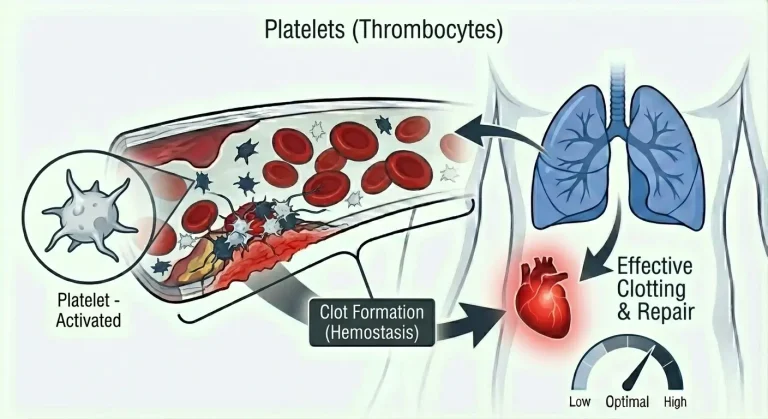
Platelets, also called thrombocytes, are small cell fragments that circulate in your bloodstream and play the critical role of preventing bleeding. They’re not complete cells—they’re fragments of larger cells called megakaryocytes that reside in bone marrow.
Megakaryocytes are enormous cells with multiple copies of their genetic material. They extend long projections (proplatelets) into bone marrow blood vessels, and these projections break apart into thousands of individual platelet fragments that enter circulation. A single megakaryocyte produces 2,000-3,000 platelets.
Normal platelet count ranges from approximately 150,000 to 400,000 platelets per microliter of blood (some labs use 150,000-450,000/μL). Your body maintains about 1-1.5 trillion platelets in circulation at any given time. This seems like an enormous number, but platelets are tiny—only 2-3 micrometers in diameter, much smaller than red blood cells.
Platelets live about 8-10 days in circulation before they’re removed by the spleen and liver. Your bone marrow must constantly produce new platelets to replace those removed—approximately 35,000 platelets per microliter per day. This high turnover rate means platelet count can change relatively quickly in response to various conditions.
The primary function of platelets is hemostasis—stopping bleeding. When a blood vessel is damaged, platelets adhere to the exposed collagen at the injury site, become activated and change shape (extending projections to increase surface area), release chemical signals that attract more platelets, aggregate together to form a platelet plug, and provide a surface for the coagulation cascade that forms a stable fibrin clot.
Without adequate platelets, even minor injuries can cause prolonged bleeding. With too many platelets or abnormally sticky platelets, inappropriate clotting can occur, potentially causing heart attacks, strokes, or other thrombotic events.
But platelets do more than just clot. They release growth factors that promote tissue healing and blood vessel repair, contain immune mediators and can interact with white blood cells, participate in inflammatory responses, and serve as markers of bone marrow health and overall physiological status.
Why Platelet Count Matters for Health
Platelet count reveals critical information about bleeding risk, bone marrow function, inflammatory states, and various disease processes.
Bleeding risk depends on platelet count. Normal counts (150,000-400,000/μL) provide excellent protection against bleeding even from significant injuries. Mild thrombocytopenia (100,000-150,000/μL) typically causes no bleeding symptoms—the body has enough platelets for normal hemostasis. Moderate thrombocytopenia (50,000-100,000/μL) increases risk of bleeding with trauma or surgery but rarely causes spontaneous bleeding. Severe thrombocytopenia (below 50,000/μL) causes easy bruising, petechiae (small red dots from bleeding under skin), prolonged bleeding from minor cuts, and risk of spontaneous bleeding. Critical thrombocytopenia (below 10,000-20,000/μL) creates serious risk of spontaneous internal bleeding including life-threatening brain hemorrhage.
The relationship between platelet count and bleeding isn’t linear—you don’t need 400,000 platelets for optimal clotting. Even 50,000-75,000 platelets provides adequate hemostasis for most situations. The body has substantial reserve capacity.
Bone marrow health is reflected in platelet production. Since platelets live only 8-10 days, maintaining normal counts requires constant bone marrow production. Declining platelet counts can be an early sign of bone marrow suppression from medications (chemotherapy, certain antibiotics, anti-inflammatory drugs), bone marrow failure (aplastic anemia), bone marrow infiltration (leukemia, lymphoma, metastatic cancer), or nutritional deficiencies affecting megakaryocyte production (vitamin B12, folate).
Inflammatory states affect platelet count. Acute inflammation and infection often cause reactive thrombocytosis—platelet count rises in response to inflammatory cytokines. This is why platelet count can spike to 500,000-700,000/μL during infections, after surgery, or with chronic inflammatory conditions. Conversely, severe sepsis can cause thrombocytopenia as platelets are consumed in widespread clotting or suppressed by inflammatory mediators.
Immune function and autoimmune diseases frequently affect platelets. Immune thrombocytopenia (ITP) occurs when the immune system produces antibodies against platelets, causing premature destruction. This can drop platelet counts to dangerously low levels (below 20,000-30,000/μL) despite normal bone marrow production. Other autoimmune conditions (lupus, rheumatoid arthritis) can also affect platelet counts.
Iron deficiency paradoxically often causes high platelet counts. When iron stores are depleted, bone marrow produces more platelets—sometimes reaching 600,000-800,000/μL. This reactive thrombocytosis resolves when iron deficiency is corrected. The mechanism isn’t fully understood but likely involves shared pathways between red blood cell and platelet production.
Normal vs. Optimal Platelet Count
Standard reference ranges for platelet count are typically:
Normal: 150,000-400,000/μL (some labs use 150,000-450,000/μL)
These ranges are designed to identify thrombocytopenia (too few platelets, risk of bleeding) and thrombocytosis (too many platelets, potential clotting risk).
Optimal platelet count for health:
150,000-350,000/μL, ideally 200,000-300,000/μL
These levels ensure excellent hemostasis without excessive clotting risk. Counts at the very high end of normal (above 400,000/μL) warrant investigation even when technically “normal,” particularly if this represents an increase from previous values.
Important considerations for interpretation:
Platelets naturally vary somewhat between individuals. Someone whose baseline is consistently 180,000-200,000/μL is different from someone whose baseline is 300,000-350,000/μL, even though both are “normal.” What matters is your individual pattern and whether counts are changing.
Trends matter more than single values. A platelet count dropping from 350,000/μL to 180,000/μL over several months deserves investigation even though both values are “normal.” A 50% decline suggests something is suppressing platelet production or increasing destruction.
Mild thrombocytopenia (100,000-150,000/μL) is often benign, particularly if stable over time. Some people have baseline counts in this range without any underlying pathology. But new thrombocytopenia or progressive decline requires investigation.
Reactive thrombocytosis (450,000-700,000/μL) in response to inflammation, infection, iron deficiency, or bleeding is common and typically resolves when the underlying condition is addressed. This is different from primary thrombocytosis due to bone marrow disorders.
Very high platelet counts (above 600,000-800,000/μL), particularly if persistent, require investigation for myeloproliferative disorders like essential thrombocythemia or polycythemia vera, even when there are no symptoms.
Very low platelet counts (below 100,000/μL) always require investigation to identify the cause and assess bleeding risk.
What Causes Low Platelet Count (Thrombocytopenia)?
Thrombocytopenia results from decreased platelet production, increased platelet destruction, or sequestration of platelets in an enlarged spleen.
Decreased platelet production occurs when bone marrow can’t produce adequate megakaryocytes or platelets. Bone marrow suppression from medications is common—chemotherapy drugs directly suppress megakaryocyte production, certain antibiotics (particularly sulfa drugs, vancomycin), anti-inflammatory medications (NSAIDs), anticonvulsants, and other medications can suppress platelet production. Bone marrow failure from aplastic anemia, myelodysplastic syndromes, or bone marrow damage causes low production of all blood cell types including platelets. Bone marrow infiltration by leukemia, lymphoma, or metastatic cancer crowds out normal megakaryocytes and reduces platelet production.
Nutritional deficiencies affecting DNA synthesis impair megakaryocyte development. Vitamin B12 deficiency and folate deficiency cause ineffective platelet production alongside macrocytic anemia (large red blood cells). Platelets may be mildly to moderately reduced (100,000-150,000/μL typically) and rise when deficiency is corrected.
Viral infections can suppress platelet production or increase destruction. Many viruses including HIV, hepatitis C, Epstein-Barr virus (mono), cytomegalovirus, and even common respiratory viruses can cause temporary thrombocytopenia. COVID-19 commonly causes mild thrombocytopenia during acute infection.
Increased platelet destruction occurs when platelets are removed from circulation faster than bone marrow can replace them. Immune thrombocytopenia (ITP) is the most common cause—the immune system produces antibodies against platelet surface proteins, marking them for destruction by the spleen. This can drop counts to very low levels (below 20,000-30,000/μL) despite normal or even increased bone marrow production. ITP can be acute (often following viral infections in children) or chronic (more common in adults, particularly women).
Drug-induced immune thrombocytopenia occurs when medications trigger antibody formation against platelets. Common culprits include heparin (causing heparin-induced thrombocytopenia or HIT, which paradoxically increases clotting risk), quinine and quinidine, certain antibiotics, and antiplatelet medications in some individuals.
Thrombotic microangiopathies are serious conditions where platelets are consumed in widespread small-vessel clotting. Thrombotic thrombocytopenic purpura (TTP) causes severe thrombocytopenia, hemolytic anemia, kidney injury, fever, and neurological symptoms—a medical emergency requiring urgent treatment. Hemolytic uremic syndrome (HUS) similarly causes thrombocytopenia with kidney injury and hemolytic anemia, often following infection with certain E. coli strains.
Disseminated intravascular coagulation (DIC) consumes platelets and clotting factors in widespread clotting throughout the body, typically in the setting of severe sepsis, trauma, cancer, or obstetric complications. This is a medical emergency.
Pregnancy-related thrombocytopenia is common and usually mild. Gestational thrombocytopenia affects 5-10% of pregnancies, causing platelet counts of 100,000-150,000/μL without risk to mother or baby. More severe thrombocytopenia in pregnancy might indicate HELLP syndrome (hemolysis, elevated liver enzymes, low platelets) or preeclampsia—serious conditions requiring urgent obstetric management.
Splenic sequestration occurs when an enlarged spleen (splenomegaly) traps and holds platelets, removing them from circulation. Causes of splenomegaly include liver disease with portal hypertension (cirrhosis), blood disorders, infections, and lymphomas. Up to 90% of platelets can be sequestered in a very enlarged spleen, dramatically lowering circulating platelet count.
Alcohol use can cause thrombocytopenia through multiple mechanisms including direct bone marrow suppression, folate deficiency, liver disease causing splenomegaly, and nutritional deficiencies.
What Causes High Platelet Count (Thrombocytosis)?
Thrombocytosis (platelet count above 400,000-450,000/μL) is categorized as reactive (secondary) or primary (clonal).
Reactive thrombocytosis is far more common and occurs when platelet production increases in response to various stimuli. The elevated count is a response to another condition rather than a primary bone marrow disorder.
Iron deficiency is one of the most common causes of reactive thrombocytosis. Platelet counts often rise to 500,000-700,000/μL or even higher when iron stores are depleted. The mechanism isn’t fully understood but likely involves thrombopoietin (the hormone that stimulates platelet production) being affected by iron status. Correcting iron deficiency normalizes platelet count over weeks to months.
Inflammation and infection stimulate platelet production through inflammatory cytokines, particularly IL-6. Acute infections (pneumonia, urinary tract infections, skin infections) commonly raise platelet counts to 400,000-600,000/μL. Chronic inflammatory conditions (rheumatoid arthritis, inflammatory bowel disease, vasculitis) often maintain mildly elevated counts (400,000-500,000/μL). The inflammation resolves, platelet count normalizes.
Bleeding and hemolysis increase platelet production as the bone marrow responds to blood loss. Acute bleeding triggers increased production. Chronic GI bleeding from ulcers or other sources can maintain elevated counts. Hemolytic anemias (where red blood cells are destroyed prematurely) often cause reactive thrombocytosis.
Tissue damage from surgery, trauma, burns, or myocardial infarction (heart attack) triggers reactive thrombocytosis as part of the healing response. Counts typically peak 1-2 weeks after the injury and gradually normalize.
Splenectomy (surgical removal of the spleen) causes persistent mild thrombocytosis because the spleen normally removes some circulating platelets. After splenectomy, counts typically rise to 400,000-600,000/μL and may remain mildly elevated indefinitely.
Cancer, particularly solid tumors, can cause reactive thrombocytosis through inflammatory cytokine production. This is sometimes called “paraneoplastic thrombocytosis.” Lung cancer, gastrointestinal cancers, ovarian cancer, and others commonly cause elevated platelet counts.
Recovery from bone marrow suppression often causes temporary thrombocytosis as platelet production rebounds. After chemotherapy, stopping medications that suppressed production, or recovery from viral infections, counts may temporarily spike above normal before settling back.
Primary thrombocytosis results from bone marrow disorders where megakaryocytes overproduce platelets independent of normal regulatory signals.
Essential thrombocythemia (ET) is a chronic myeloproliferative disorder causing sustained platelet counts typically above 450,000-600,000/μL, often reaching 800,000-1,500,000/μL or higher. This is caused by mutations in genes regulating platelet production (JAK2, CALR, or MPL mutations in most cases). ET increases risk of both bleeding (paradoxically, very high platelet counts can cause acquired von Willebrand disease) and clotting (stroke, heart attack, deep vein thrombosis). Diagnosis requires excluding reactive causes and typically includes bone marrow biopsy and genetic testing.
Polycythemia vera (PV) is another myeloproliferative disorder primarily causing elevated red blood cells (high hemoglobin and hematocrit) but also commonly elevates platelets. Platelet counts in PV are often 400,000-700,000/μL.
Other myeloproliferative disorders including primary myelofibrosis and chronic myeloid leukemia can cause thrombocytosis, though they typically present with other blood count abnormalities.
The distinction between reactive and primary thrombocytosis matters enormously. Reactive thrombocytosis is common, usually benign, and resolves when the underlying condition is addressed. Primary thrombocytosis requires hematology evaluation and often lifelong management to reduce clotting and bleeding risks.
Platelets and Related Blood Markers
Platelet count should be interpreted alongside other complete blood count markers and clinical context.
Mean platelet volume (MPV) measures average platelet size. Normal range is approximately 7.5-11.5 fL (femtoliters). Young platelets just released from bone marrow are larger than older platelets. High MPV with low platelet count suggests increased platelet turnover—the bone marrow is producing new platelets rapidly to replace those being destroyed, typical of immune thrombocytopenia or increased consumption. Low MPV with low platelet count suggests decreased platelet production from bone marrow suppression or failure. High MPV with normal or high platelet count can occur in myeloproliferative disorders. Low MPV with high platelet count is less common but might occur in iron deficiency.
Platelet distribution width (PDW) measures variation in platelet size, similar to RDW for red blood cells. High PDW indicates significant size variation, which might suggest active platelet production (mix of young large and older smaller platelets) or certain bone marrow disorders.
White blood cell count (WBC) provides context for platelet changes. Low platelets with low WBC suggests bone marrow suppression affecting multiple cell lines (medications, bone marrow failure, leukemia). High platelets with high WBC suggests infection or inflammation causing reactive increases in both. Abnormal white blood cell differential (particularly high immature cells or blasts) alongside abnormal platelets raises concern for leukemia.
Red blood cell count, hemoglobin, and hematocrit provide additional bone marrow context. Low platelets with low RBC/hemoglobin suggests bone marrow suppression or failure affecting multiple cell lines, B12 or folate deficiency (megaloblastic anemia with thrombocytopenia), or bone marrow infiltration by cancer. High platelets with low RBC/hemoglobin suggests iron deficiency (causing both anemia and reactive thrombocytosis), chronic bleeding (bone marrow responds by increasing platelet production), or hemolytic anemia.
MCV (mean cell volume) combined with platelet count helps identify specific deficiencies. High MCV (large red blood cells) with low platelets suggests B12 or folate deficiency or certain medications. Low MCV (small red blood cells) with high platelets suggests iron deficiency.
Inflammatory markers including CRP or ESR, when elevated alongside high platelet count, support reactive thrombocytosis from inflammation rather than primary bone marrow disorder.
Ferritin assessment is essential when platelet count is elevated—check iron stores to rule out iron deficiency as the cause of thrombocytosis.
Platelet Count and Clotting vs. Bleeding Risk
Platelet count affects both bleeding and clotting risk, but the relationship isn’t always intuitive.
Low platelet counts increase bleeding risk in a predictable way. Above 100,000/μL, bleeding risk is minimal even with trauma or surgery. 50,000-100,000/μL is adequate for most situations but increases risk with significant trauma or invasive procedures. 20,000-50,000/μL causes easy bruising, petechiae, and bleeding with minor trauma. Below 10,000-20,000/μL creates serious risk of spontaneous bleeding including life-threatening hemorrhage.
Medical procedures have specific platelet thresholds. Most surgeries require platelets above 50,000/μL. Major surgery or neurosurgery typically requires above 80,000-100,000/μL. Epidural or spinal anesthesia requires above 80,000-100,000/μL due to bleeding risk in the spinal space. Dental procedures are generally safe above 30,000-50,000/μL. Platelet transfusions can temporarily raise counts for procedures when necessary.
High platelet counts create more complex clotting risk. Moderate thrombocytosis (400,000-600,000/μL) from reactive causes typically doesn’t increase clotting risk significantly. The underlying inflammation might increase risk, but elevated platelets alone are usually benign.
Very high platelet counts (above 800,000-1,000,000/μL) can paradoxically increase both clotting and bleeding risk. Clotting risk increases from sheer platelet number and potential platelet activation. Bleeding risk can occur because very high platelet counts can cause acquired von Willebrand disease—platelets absorb von Willebrand factor from plasma, depleting it and impairing normal clotting function.
Essential thrombocythemia and other primary platelet disorders carry significant clotting risk even with platelet counts of 450,000-600,000/μL because the platelets are often dysfunctional and hyperactive. These patients require antiplatelet therapy (aspirin) and sometimes cytoreductive therapy (medications to lower platelet count) to reduce stroke and heart attack risk.
When Platelet Abnormalities Require Medical Attention
Certain platelet findings require urgent or prompt medical evaluation rather than routine monitoring.
Seek immediate medical attention if you have platelet count below 20,000-30,000/μL, particularly with bleeding symptoms (petechiae, bruising, nosebleeds, bloody gums). New severe thrombocytopenia with bleeding signs suggesting TTP or HUS (confusion, fever, kidney problems, severe anemia alongside low platelets). Platelet count below 50,000/μL with need for urgent surgery or invasive procedure.
Seek prompt medical evaluation (within days) if you have new thrombocytopenia below 100,000/μL without obvious cause. Platelet count dropping by 50% or more over weeks to months even if still “normal.” Platelets persistently above 600,000-800,000/μL without identified reactive cause. Thrombocytosis with other blood count abnormalities (high or low WBC, anemia, abnormal blood smear). Easy bruising, petechiae, or prolonged bleeding with platelet count between 50,000-100,000/μL.
Routine monitoring is appropriate for stable mild thrombocytopenia (100,000-150,000/μL) that’s been present for months to years without progression. Known reactive thrombocytosis from identified cause (iron deficiency, inflammation) being treated. Mild platelet count elevation (400,000-500,000/μL) with clear reactive cause.
Frequently Asked Questions
What is a normal platelet count?
Normal range is 150,000-400,000 platelets per microliter of blood (some labs use 150,000-450,000/μL). Optimal for most people is 200,000-300,000/μL. What matters most is your individual pattern and whether counts are changing over time, not just whether you fall within the reference range.
Can low platelets cause fatigue?
Low platelets alone don’t directly cause fatigue—platelets don’t carry oxygen or affect energy production. However, the underlying conditions causing low platelets often do cause fatigue. For example, B12 deficiency causes both thrombocytopenia and profound fatigue. Bone marrow disorders causing low platelets also typically cause anemia, which does cause fatigue. Chronic diseases and inflammation causing thrombocytopenia commonly cause fatigue through other mechanisms.
What does it mean if platelets are high but everything else is normal?
Isolated thrombocytosis (high platelets with normal other blood counts) most commonly indicates reactive thrombocytosis from iron deficiency, inflammation, recent bleeding, or tissue damage. Check ferritin to rule out iron deficiency. Consider recent infections, injuries, or inflammatory conditions. If platelets are persistently above 600,000-800,000/μL without identified cause, evaluation for primary bone marrow disorders is warranted.
Can dehydration affect platelet count?
Dehydration concentrates blood and can artificially elevate platelet count by reducing plasma volume while platelet mass remains constant. The effect is typically modest (10-20% increase) compared to the dramatic changes seen with true bone marrow disorders. Proper hydration normalizes the measurement. This is why consistent hydration status matters for accurate interpretation.
Do I need treatment for mild thrombocytopenia?
Mild thrombocytopenia (100,000-150,000/μL) often doesn’t require treatment if stable, asymptomatic, and without identified serious underlying cause. Many people maintain counts in this range for years without problems. However, the underlying cause should be investigated—B12 or folate deficiency should be corrected, medications causing suppression should be reviewed, and autoimmune conditions should be evaluated. If counts are stable and you’re not experiencing bleeding, treatment might not be necessary.
Can medications cause high or low platelets?
Yes, many medications affect platelet count. Medications that can lower platelets include chemotherapy drugs, certain antibiotics (sulfa drugs, vancomycin, linezolid), anti-inflammatory medications (NSAIDs), anticonvulsants (valproic acid, carbamazepine), certain heart medications (digoxin, procainamide), and immunosuppressants. Medications that can raise platelets include withdrawal from medications that were suppressing counts and certain growth factors. Always review medications when platelet counts change unexpectedly.
How quickly can platelet count change?
Platelet count can change relatively quickly because platelets only live 8-10 days. With severe bone marrow suppression (chemotherapy), counts can drop significantly within 1-2 weeks. With immune destruction (ITP), counts can plummet within days. Conversely, reactive thrombocytosis from infection can develop within days to weeks. Recovery from suppression or treatment of ITP can raise counts significantly within 1-2 weeks. This rapid turnover is why platelet counts are sensitive markers of acute changes in bone marrow function or platelet destruction.
Should I be concerned about platelets at 400,000/μL?
Platelets at 400,000/μL (upper limit of normal) aren’t automatically concerning but warrant consideration of causes. Check for iron deficiency (ferritin), recent infections or inflammatory conditions, recent bleeding or surgery, and underlying chronic inflammatory diseases. If there’s an identified reactive cause and counts aren’t climbing further, this is likely benign. If counts are rising progressively or reach 500,000/μL or higher without identified cause, further evaluation is warranted.
Testing Platelets With ApexBlood
ApexBlood’s comprehensive blood panel includes platelet count as part of the complete blood count (CBC), along with all related markers necessary to understand your platelet health and what might be affecting it: mean platelet volume (MPV) for platelet size and turnover assessment, hemoglobin, hematocrit, and RBC count for bone marrow context, white blood cell count and differential for immune and bone marrow function, and MCV for red blood cell size (helps identify B12/folate deficiency or iron deficiency).
Our testing also includes critical markers that reveal what might be driving platelet abnormalities: ferritin for iron storage status (iron deficiency commonly causes high platelets), vitamin B12 for bone marrow function (deficiency causes low platelets), complete metabolic panel for kidney and liver function affecting platelet health, and inflammatory markers when indicated.
This comprehensive approach reveals not just your platelet count but the complete picture—whether low platelets reflect bone marrow suppression, increased destruction, or nutritional deficiency, whether high platelets are from iron deficiency, inflammation, or require evaluation for primary disorders, and how platelet count is changing over time through regular monitoring.
Platelet count isn’t meaningful in isolation. You need context from other blood counts, iron studies, B12 levels, and inflammatory markers. You need to know your trend over time—is this your stable baseline or is something changing?
You can’t optimize what you don’t measure. Stop accepting platelet results without understanding what they reveal about bone marrow health, inflammatory status, and potential underlying conditions.
Get comprehensive testing including platelet count and complete blood analysis – $189
The Bottom Line on Platelets
Platelet count measures the number of clotting cell fragments in your bloodstream and provides critical information about bleeding risk, bone marrow function, inflammatory states, and various disease processes.
Normal platelet count is 150,000-400,000/μL, with optimal being 200,000-300,000/μL. What matters most is your individual pattern and whether counts are changing over time, not just whether you fall within reference ranges.
Low platelets (thrombocytopenia) can result from decreased production (bone marrow suppression from medications, B12/folate deficiency, bone marrow disorders), increased destruction (immune thrombocytopenia, infections, drug reactions), or splenic sequestration. Bleeding risk increases substantially below 50,000/μL and becomes critical below 20,000/μL.
High platelets (thrombocytosis) most commonly result from reactive causes including iron deficiency, inflammation, infection, bleeding, or tissue damage. Primary thrombocytosis from bone marrow disorders (essential thrombocythemia) is less common but requires hematology evaluation and management.
Platelet count must be interpreted alongside other blood markers including MPV (platelet size), complete blood count (WBC, RBC, hemoglobin), MCV (red cell size), ferritin (iron stores), and B12 (bone marrow function). The pattern of abnormalities reveals specific diagnoses.
Trends over time matter enormously. A 50% drop in platelets even within “normal range” deserves investigation. Progressive elevation even before reaching “abnormal” levels warrants evaluation.
High performers track platelet count over time as a sensitive marker of bone marrow health, nutritional status, inflammatory states, and medication effects. They don’t wait for counts to become critically abnormal—they investigate changes early when intervention is most effective.
Stop accepting platelet results without understanding what they reveal about underlying health. Stop accepting “normal” when changing trends indicate developing problems.
Medical Disclaimer: This information is for educational purposes and does not constitute medical advice. Platelet count abnormalities require evaluation by qualified healthcare providers. Never make treatment decisions based solely on internet information. Always consult licensed medical professionals for diagnosis and treatment.