
Total protein is the sum of all proteins circulating in your blood – primarily albumin and globulins. As a single number, it provides a broad indicator of your nutritional status, liver function, kidney health, immune system activity, and overall protein metabolism. It is not the most precise or specific biomarker on a comprehensive panel, but it is a valuable first-line screening tool that, when interpreted alongside albumin and globulin individually, can point toward nutritional deficiency, liver disease, kidney protein loss, chronic infection, inflammatory states, or blood cancers that might otherwise go undetected on a routine panel. Understanding what your total protein level actually means for your health requires understanding the components that make it up.
What Is Total Protein?
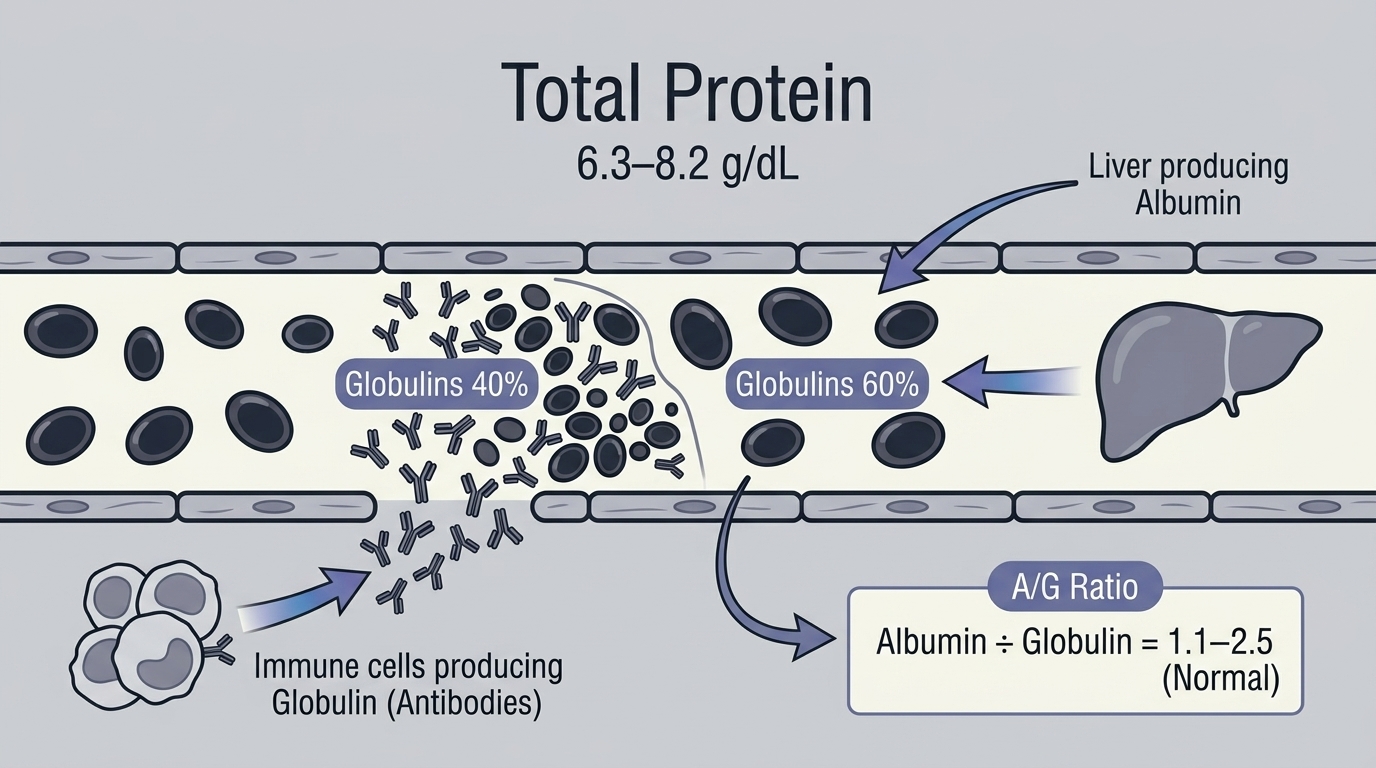
Total protein measures the combined concentration of all proteins in your blood serum. The two major protein fractions are albumin (typically 60% of total protein) and globulins (the remaining 40%), which include immunoglobulins (antibodies), complement proteins, transport proteins, clotting factors, and acute phase reactants. The ratio of albumin to globulin – the A/G ratio – is calculated from the same measurement and provides additional diagnostic information about what is driving any total protein abnormality.
Proteins in the blood serve diverse essential functions: maintaining osmotic pressure to keep fluid within blood vessels, transporting hormones, minerals, and medications, providing immune defense through antibodies, participating in clotting cascades, and acting as enzymes and signaling molecules. The liver is responsible for producing albumin and most non-immune globulins. Plasma cells in bone marrow and lymphoid tissue produce immunoglobulins. Total protein therefore reflects the combined output of multiple organ systems, making it a genuinely integrative biomarker.
Why Total Protein Matters for Performance and Health
For high performers and health optimizers, total protein provides a useful cross-check on whether dietary protein intake and absorption are adequate to support the demands being placed on the body. Intense training increases protein turnover – the continuous breakdown and synthesis of muscle proteins – and adequate circulating protein is part of the infrastructure supporting this process. Low total protein, even when not dramatically below the reference range, can indicate protein malnutrition, impaired absorption, or excessive losses that will limit training adaptation, immune function, wound healing, and recovery.
Beyond nutrition, total protein is a screening tool for serious underlying conditions. Elevated total protein – driven by elevated globulins – can be an early signal of multiple myeloma, a blood cancer that produces excessive abnormal immunoglobulins. Chronic infections, inflammatory diseases, and autoimmune conditions also elevate globulins. Low total protein driven by low albumin points toward liver disease, kidney protein loss (nephrotic syndrome), or severe malnutrition. Interpreting total protein correctly requires splitting it into its albumin and globulin components and considering the clinical context.
Normal vs. Optimal Total Protein Levels
Standard Reference Ranges: Most laboratories report total protein as normal between 6.0 and 8.5 g/dL. The lower bound identifies clinically significant hypoproteinemia – protein low enough to affect osmotic pressure and organ function. The upper bound identifies hyperglobulinemia warranting investigation for immune or neoplastic conditions.
Optimal Total Protein for Performance: For most well-nourished adults engaged in regular physical activity, total protein in the range of 7.0-8.0 g/dL alongside normal albumin (3.5-5.0 g/dL) and normal globulins (2.0-3.5 g/dL) suggests adequate protein metabolism. Total protein consistently below 6.5 g/dL – particularly with low albumin – warrants investigation of dietary protein intake, absorption, liver function, and kidney protein losses. Total protein above 8.5 g/dL – particularly driven by elevated globulins – warrants investigation for chronic infection, autoimmune disease, or multiple myeloma.
What Causes Low Total Protein?
Malnutrition and inadequate dietary protein intake – insufficient total calories or insufficient protein specifically – are the most common causes globally. Liver disease impairs albumin synthesis because the liver is the sole producer of albumin, and severe liver disease produces dramatic protein drops. Nephrotic syndrome (kidney disease causing protein spilling into urine) causes massive protein losses that deplete serum albumin and total protein despite adequate synthesis. Protein-losing enteropathy (inflammatory bowel disease, celiac disease, or other gut conditions) causes excessive GI protein losses. Severe burns cause massive protein losses through the skin. Systemic inflammation and critical illness consume protein at high rates while simultaneously suppressing synthesis. Malabsorption from any cause (celiac, pancreatic insufficiency, bacterial overgrowth) impairs protein absorption even when dietary intake is adequate.
What Causes High Total Protein?
Dehydration is the most common cause of mildly elevated total protein – as plasma volume contracts, protein concentration rises even though total protein mass is unchanged. This is a pseudohyperproteinemia that resolves with rehydration. True elevated total protein from elevated globulins has several clinically important causes. Multiple myeloma and other plasma cell dyscrasias produce monoclonal immunoglobulins that dramatically elevate total protein – the classic pattern is very high total protein with low albumin and a monoclonal protein (M-spike) on serum protein electrophoresis. Chronic infections (HIV, hepatitis B or C, bacterial endocarditis, tuberculosis) stimulate polyclonal globulin production. Autoimmune diseases including lupus, rheumatoid arthritis, and liver disease produce polyclonal globulin elevation. Chronic liver disease (cirrhosis) characteristically shows low albumin alongside elevated globulins (particularly gamma globulins), producing a total protein that may appear deceptively normal despite serious liver dysfunction.
The A/G Ratio: What It Reveals
The albumin-to-globulin (A/G) ratio – calculated by dividing albumin by globulin – is reported alongside total protein and provides important additional information. A normal A/G ratio is approximately 1.2 to 2.2, meaning albumin should be higher than globulin in a healthy person. A low A/G ratio (below 1.0) indicates that globulins are elevated relative to albumin, which points toward chronic liver disease, autoimmune conditions, or chronic infections that stimulate globulin production while the liver’s albumin production is impaired. A very high A/G ratio (above 2.5) with high albumin and low globulins is uncommon but can indicate immune deficiency or recent corticosteroid use. The A/G ratio often provides the interpretive key that makes total protein clinically meaningful.
Frequently Asked Questions
Does eating more protein raise my blood protein level?
Not in any significant way in healthy people. Your liver tightly regulates serum protein levels through feedback mechanisms. Dietary protein beyond current needs is catabolized for energy or converted to other molecules rather than being stored as circulating protein. Serum protein only falls when the liver cannot synthesize adequate protein (liver disease), protein is being lost (kidney or gut disease), or intake is so severely deficient that synthesis cannot be maintained. For most people with adequate diets, eating more protein does not raise total protein on a blood test.
What is a normal albumin-to-globulin ratio?
A normal A/G ratio is approximately 1.2 to 2.2. Albumin should be higher than globulin in healthy individuals. A ratio below 1.0 indicates globulins are elevated relative to albumin and should prompt investigation for liver disease, chronic infection, or autoimmune conditions. The A/G ratio is often more diagnostically valuable than total protein alone.
Can high total protein indicate cancer?
Yes – very high total protein driven by elevated globulins can be an early sign of multiple myeloma or other plasma cell disorders. Serum protein electrophoresis (SPEP) is the follow-up test that identifies whether the globulin elevation is polyclonal (usually infection or inflammation) or monoclonal (potentially a plasma cell dyscrasia requiring further workup). Any total protein consistently above 9 g/dL or an unexplained globulin above 4 g/dL warrants SPEP and physician evaluation.
How does liver disease affect total protein?
Liver disease affects total protein in a complex way. Albumin falls because the liver loses its ability to synthesize albumin. Globulins – particularly gamma globulins (immunoglobulins) – tend to rise in chronic liver disease from immune system activation. Total protein may appear deceptively normal or even elevated while albumin is critically low. This is why looking at albumin and the A/G ratio separately is more informative than total protein alone for liver health assessment.
Testing Total Protein With ApexBlood
Total protein is included in ApexBlood’s comprehensive metabolic panel alongside albumin, globulin, liver enzymes, kidney function markers, and the full metabolic picture. Seeing total protein alongside its component fractions and in the context of your liver and kidney health allows for intelligent interpretation rather than a single number viewed in isolation.
Get comprehensive testing for $189
The Bottom Line on Total Protein
Total protein is a useful screening tool that becomes genuinely valuable when interpreted alongside albumin, globulin, the A/G ratio, and clinical context. A normal total protein does not guarantee optimal protein metabolism – the composition matters as much as the total. Elevated total protein driven by globulins warrants investigation for serious underlying causes. Low total protein driven by low albumin warrants evaluation of liver, kidney, and nutritional status. Stop accepting the number at face value without understanding the story beneath it. Stop accepting “normal” when optimal is possible.
Medical Disclaimer: This information is for educational purposes and does not constitute medical advice. Total protein and protein metabolism require evaluation by qualified healthcare providers. Never make treatment decisions based solely on internet information. Always consult licensed medical professionals for diagnosis and treatment.