
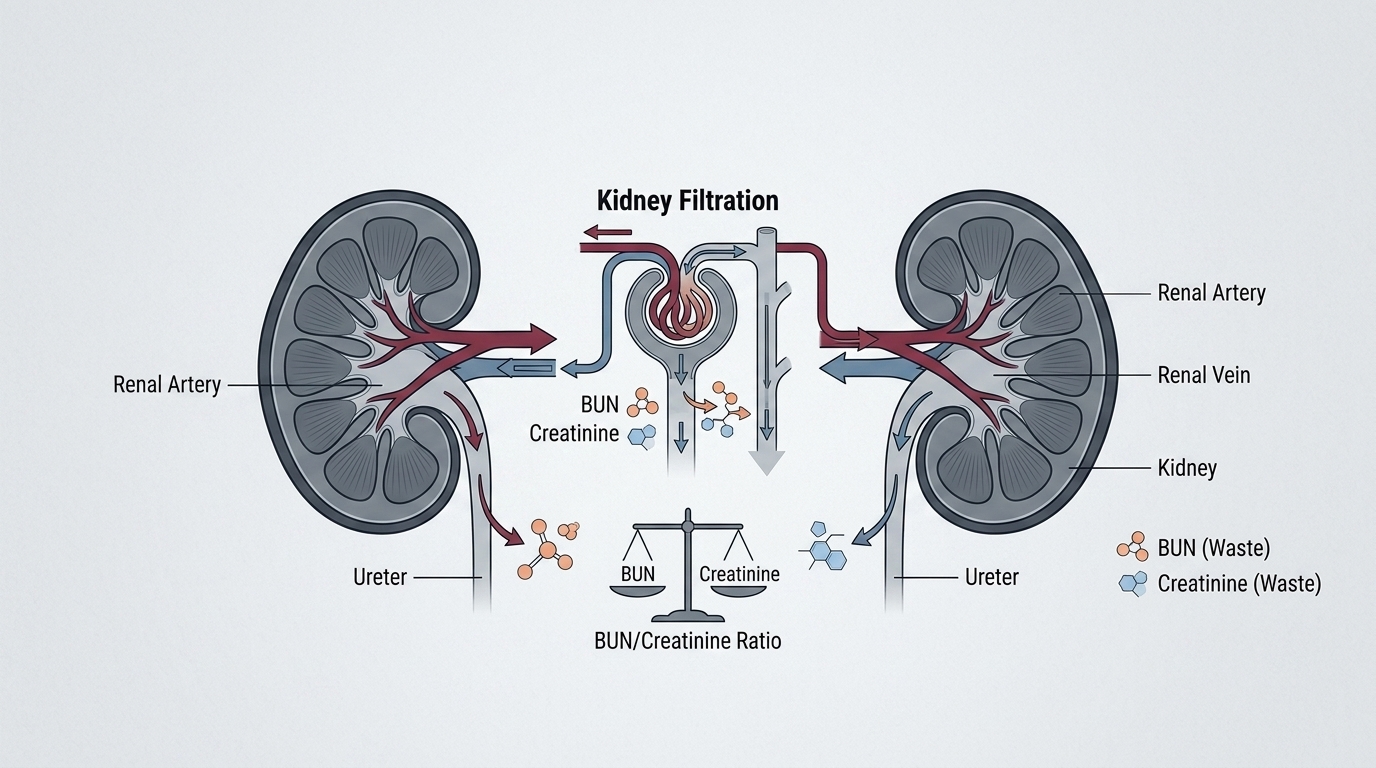
The BUN/Creatinine ratio is one of the most clinically useful — and most frequently misunderstood — values on a basic metabolic panel. While most people focus on BUN (blood urea nitrogen) and creatinine individually, it’s the ratio between them that reveals whether kidney issues, hydration status, protein metabolism, or muscle breakdown are driving any abnormalities. A ratio without context is just a number; a ratio interpreted correctly is a diagnostic tool that can differentiate between causes of kidney dysfunction before they become problems.
For high performers, athletes, and anyone optimizing health through high protein intake, aggressive training, or GLP-1 medications for weight loss, the BUN/Creatinine ratio provides insight that neither marker delivers alone. This is the test that tells you whether your kidneys are working optimally — or whether something upstream is affecting them.
What Is the BUN/Creatinine Ratio?
BUN stands for blood urea nitrogen — a measurement of the nitrogen component of urea, a waste product produced when the liver breaks down proteins and amino acids. Urea is then transported to the kidneys for filtration and excretion in urine. BUN levels reflect the balance between protein catabolism (breakdown) in the liver and kidney clearance of the resulting waste.
Creatinine is a waste product generated at a remarkably constant rate from the breakdown of creatine phosphate in muscle tissue. Because muscle generates creatinine at a steady rate proportional to muscle mass, creatinine is an excellent marker of kidney filtration efficiency — the kidneys should filter and excrete it continuously, and any rise in creatinine indicates reduced kidney filtration capacity.
The BUN/Creatinine ratio is simply BUN divided by creatinine (both in mg/dL). The ratio’s value lies in its diagnostic power: because BUN and creatinine are affected differently by various conditions, their ratio helps pinpoint the cause of any abnormality.
What Does the BUN/Creatinine Ratio Reveal?
The ratio’s clinical power comes from what drives each marker. BUN is influenced by protein intake, liver function, hydration status, and any condition causing increased protein breakdown (catabolic states, GI bleeding, steroid use). Creatinine is primarily determined by kidney function and muscle mass. When you compare them as a ratio, patterns emerge that reveal which system is actually driving the abnormality.
A high ratio (above 20) with elevated BUN but relatively normal creatinine suggests pre-renal causes — problems before the kidney: dehydration (the most common cause, as less fluid means less dilution of BUN), high protein intake or protein catabolism (trauma, fasting, corticosteroid use), GI bleeding (blood protein is broken down to urea), heart failure (reduced blood flow to kidneys), or early/mild dehydration. This pattern tells you the kidneys themselves may be functioning fine but are stressed by upstream factors.
A normal or low ratio (below 10–12) with elevated creatinine suggests the problem is intrinsic kidney dysfunction — the kidneys themselves aren’t filtering efficiently. This warrants investigation for chronic kidney disease, acute kidney injury, rhabdomyolysis (extreme muscle breakdown releasing large amounts of creatinine), or conditions causing reduced kidney blood flow.
A low ratio (below 10) with both markers low or normal may indicate malnutrition, severe liver disease (which impairs urea synthesis from protein), low protein intake, or conditions causing water retention (SIADH, overhydration).
Normal vs. Optimal BUN/Creatinine Ratio
Standard reference ranges for the BUN/Creatinine ratio: Normal is 10–20:1, with most labs flagging values below 10 or above 20 as abnormal. The optimal range for metabolic health is 12–18:1, sitting comfortably within normal limits with good margin on either side.
Context matters significantly when interpreting the ratio. A high-protein diet (common among athletes and those on body composition optimization protocols) will naturally push BUN higher, potentially elevating the ratio above 20 even with excellent kidney function. Similarly, people with high muscle mass will have higher baseline creatinine, which lowers the ratio. The ratio is most meaningful when interpreted alongside absolute values, hydration status, and individual context.
What Causes an Abnormal BUN/Creatinine Ratio?
Common causes of a high BUN/Creatinine ratio (above 20) include dehydration (the single most common cause — easily corrected), high-protein diet or protein supplements, upper GI bleeding (blood in the GI tract is digested and absorbed as protein), excessive muscle breakdown from injury, surgery, or intense exercise (rhabdomyolysis), corticosteroid use (which increases protein catabolism), heart failure or shock (reduced kidney blood flow), fever or other catabolic illnesses, and early kidney disease or reduced kidney perfusion.
Common causes of a low BUN/Creatinine ratio (below 10) include low protein diet or malnutrition (less protein means less urea production), severe liver disease (impaired urea synthesis), overhydration or water retention, rhabdomyolysis in the context of acute kidney injury (dramatically elevated creatinine from massive muscle breakdown), and pregnancy (increased kidney filtration rate dilutes creatinine).
BUN/Creatinine Ratio for Athletes and High Performers
For people training hard, eating high protein, or undergoing aggressive body composition changes, the BUN/Creatinine ratio requires careful interpretation. High protein intake routinely elevates BUN without any kidney pathology — urea is the waste product of protein metabolism, and more protein means more urea. Athletes on 1.5–2.5g protein per kilogram of body weight will commonly have BUN values in the 20–30 mg/dL range with perfectly healthy kidneys.
Similarly, people with high muscle mass will have higher baseline creatinine (more muscle = more constant creatinine production), which lowers the ratio. Interpreting this as kidney dysfunction would be an error. High muscle mass individuals often need their kidney function assessed differently — eGFR calculations that don’t account for muscle mass can falsely suggest reduced kidney function in muscular individuals.
The most important practical consideration for athletes: hydration status dramatically affects the BUN/Creatinine ratio. Testing after intense training or when chronically under-hydrated will produce a falsely high ratio. Always hydrate well in the days before blood testing for the most accurate results.
How to Optimize Your BUN/Creatinine Ratio
If your ratio is elevated primarily due to dehydration, the intervention is straightforward: drink more water. Aim for adequate hydration consistently — urine should be pale yellow. For most adults, 2–3 liters of water daily maintains adequate hydration for normal activity levels; athletes and those in hot climates need more.
If elevated due to high protein intake, moderation may be appropriate if kidney function is otherwise healthy. However, very high protein intake (above 3g/kg/day) does place additional load on the kidneys and is worth discussing with your physician if BUN is consistently elevated. If the ratio is elevated due to reduced kidney function (intrinsic renal disease), the approach shifts entirely toward protecting kidney function — blood pressure management, glucose control, avoiding nephrotoxic substances, and potentially nephrology referral depending on severity.
Kidney health is foundational to overall metabolic health. Comprehensive blood testing that includes BUN, creatinine, eGFR, and electrolytes provides the full picture of kidney function — far more than any single marker. If kidney function issues are identified, optimizing overall metabolic health through longevity-focused protocols addressing inflammation, glucose control, and blood pressure provides the most comprehensive support.
Frequently Asked Questions About BUN/Creatinine Ratio
What is a normal BUN/Creatinine ratio?
The standard reference range is 10–20:1. Values outside this range warrant investigation but aren’t automatically pathological — context (hydration, protein intake, muscle mass, recent exercise) is essential for accurate interpretation. The optimal range for most people is 12–18:1.
Does a high BUN/Creatinine ratio always mean kidney disease?
No. A high ratio most commonly reflects dehydration or high protein intake rather than kidney disease. When BUN is elevated but creatinine is normal or only mildly elevated, the kidneys themselves are often functioning fine — the problem is upstream (less blood flow due to dehydration, excess protein to process, or GI bleeding adding protein load). Kidney disease typically presents with both BUN and creatinine elevated, with a normal or low ratio.
Can dehydration affect my BUN/Creatinine ratio?
Yes, significantly. Dehydration is the most common cause of an elevated BUN/Creatinine ratio. When you’re dehydrated, less fluid dilutes BUN in the blood, concentrating it. This gives a falsely high ratio that has nothing to do with kidney function. Always ensure adequate hydration in the days before blood testing for accurate results.
Does high protein intake raise the BUN/Creatinine ratio?
Yes. BUN is a direct byproduct of protein metabolism — more protein means more urea production and higher BUN. Athletes and high protein dieters commonly have BUN in the 20–30+ range with a BUN/Creatinine ratio above 20, despite completely healthy kidney function. This is normal and expected, not pathological, when creatinine is within normal range.
What’s the difference between BUN and creatinine tests?
BUN (blood urea nitrogen) reflects protein metabolism and kidney clearance of urea waste — it’s affected by protein intake, liver function, hydration, and muscle breakdown. Creatinine is generated at a constant rate from muscle and cleared exclusively by the kidneys — it’s the more specific kidney function marker. Together as a ratio, they provide diagnostic information neither delivers alone.
Is the BUN/Creatinine ratio included in ApexBlood’s panel?
Yes. BUN, creatinine, and the calculated BUN/Creatinine ratio are included in ApexBlood’s comprehensive metabolic panel, alongside eGFR, electrolytes, and other kidney function markers that provide the full picture of renal health.
Test your kidney function markers and 100+ biomarkers for $189. See what we test →
The Bottom Line on BUN/Creatinine Ratio
The BUN/Creatinine ratio is a diagnostic lens that turns two ordinary kidney markers into a pattern-recognition tool. The normal range is 10–20:1. A high ratio points toward dehydration, high protein intake, or reduced kidney blood flow — not necessarily kidney disease itself. A low ratio with elevated creatinine points toward intrinsic kidney dysfunction. Context — hydration, protein intake, muscle mass, medications — is everything when interpreting the result.
For athletes, high-protein dieters, and anyone serious about their metabolic health, tracking BUN, creatinine, and eGFR together provides far more insight than any single marker. Kidney function is one of the most important and most overlooked aspects of long-term health — test it, understand it, and protect it.
Medical Disclaimer: This information is for educational purposes only and does not constitute medical advice. BUN, creatinine, and kidney function require evaluation by qualified healthcare providers. Always consult licensed medical professionals for diagnosis and treatment.