
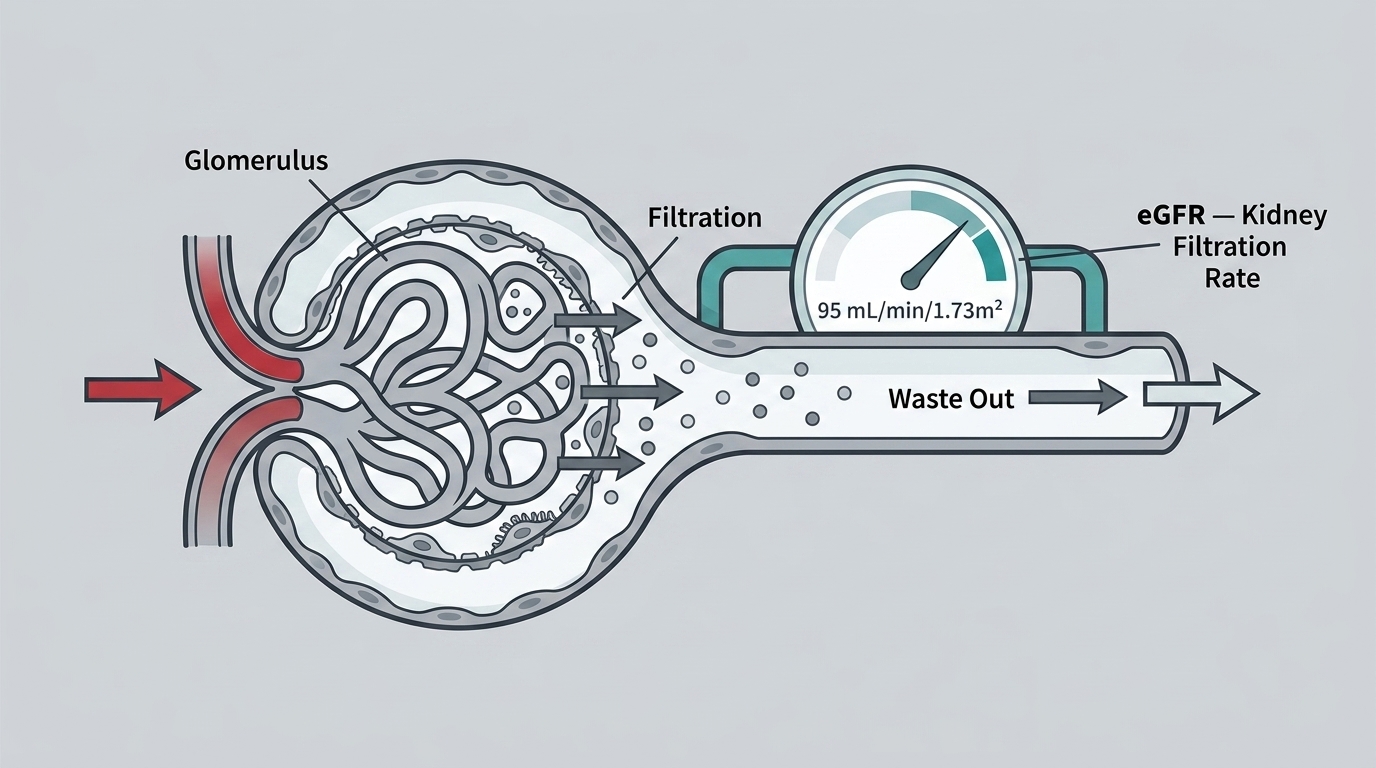
eGFR — estimated glomerular filtration rate — is the most important single number for assessing kidney health. Your kidneys filter about 180 liters of blood per day, and eGFR tells you how efficiently they’re doing it. Kidney disease kills silently: you can lose 50–60% of kidney function before experiencing any symptoms, and by the time symptoms appear, the damage is often irreversible. eGFR catches this decline early — when lifestyle and medical intervention can still make a real difference.
For anyone on long-term medications (NSAIDs, certain antibiotics, contrast dyes), managing blood pressure or diabetes, training at high intensities, or simply invested in their long-term health, eGFR is foundational data. Your kidneys don’t get a second chance — knowing where you stand is the first step to protecting them.
What Is eGFR?
Glomerular filtration rate (GFR) measures how much blood the tiny filtering units of your kidneys — the glomeruli — clean per minute. Each kidney contains approximately one million glomeruli, and their total filtering capacity represents kidney function. A normal GFR is around 90–120 mL/min/1.73m², meaning the kidneys are filtering about 90–120 milliliters of blood per minute.
Because directly measuring GFR requires complex techniques not practical for routine testing, laboratories calculate an estimated GFR (eGFR) using serum creatinine levels combined with demographic factors including age, sex, and race. The most widely used formula is the CKD-EPI (Chronic Kidney Disease Epidemiology Collaboration) equation, which provides a reliable estimate of true GFR for clinical decision-making.
The key insight: eGFR declines naturally with age (roughly 1 mL/min/1.73m² per year after age 40) and varies significantly with muscle mass (since it’s calculated from creatinine, highly muscular individuals may have falsely low eGFR). These factors make clinical context essential when interpreting the result.
Why eGFR Matters — The Silent Decline of Kidney Function
Chronic kidney disease (CKD) affects an estimated 37 million Americans, and approximately 90% of people with early-to-moderate CKD don’t know they have it. The kidneys have enormous reserve capacity: you can function normally — symptom-free — with eGFR values in the 30–59 range. By the time symptoms like fatigue, fluid retention, decreased urine output, or uremic symptoms appear, kidney function is often severely compromised.
Beyond kidney disease itself, declining eGFR is associated with dramatically increased cardiovascular risk. Kidney function and cardiovascular health are deeply intertwined — impaired kidneys lead to hypertension, fluid retention, electrolyte imbalances, and inflammatory states that accelerate arterial disease. People with CKD are far more likely to die of cardiovascular disease than from kidney failure itself. Monitoring eGFR is therefore as much a cardiovascular health measure as a kidney health measure.
For people managing diabetes, hypertension, or autoimmune conditions, eGFR monitoring is essential — these are the leading causes of progressive kidney disease. For otherwise healthy people, eGFR provides baseline data and the ability to detect unexpected declines before they become irreversible.
Normal vs. Optimal eGFR Levels
The CKD staging system classifies kidney function as follows: G1 (normal): eGFR ≥90 mL/min/1.73m² with no kidney damage markers. G2 (mildly decreased): eGFR 60–89, typically normal for adults over 60. G3a (mild to moderate decrease): eGFR 45–59. G3b (moderate to severe decrease): eGFR 30–44. G4 (severely decreased): eGFR 15–29. G5 (kidney failure): eGFR below 15, requiring dialysis or transplant.
For performance and longevity optimization, the target is eGFR above 90 mL/min/1.73m² — well within the normal range with plenty of reserve. An eGFR between 60–89 in a young or middle-aged adult warrants investigation for underlying causes, even though it’s not yet classified as kidney disease. A declining eGFR over time — even within normal range — is more clinically significant than any single value, which is why serial testing matters.
Important caveat for muscular individuals: because eGFR is calculated from creatinine, and creatinine is proportional to muscle mass, highly muscular people often have falsely low eGFR estimates. Cystatin C — an alternative kidney function marker not affected by muscle mass — can provide a more accurate assessment in these cases and is worth requesting if your eGFR seems inconsistently low for your health status.
What Causes Reduced eGFR?
The leading causes of progressive eGFR decline are diabetes (diabetic nephropathy, caused by chronic high glucose damaging the glomerular blood vessels), hypertension (high blood pressure mechanically damages kidney filtration units over time), and glomerulonephritis (immune-mediated kidney inflammation). Together, diabetes and hypertension account for the majority of chronic kidney disease cases.
Other causes include polycystic kidney disease (genetic), lupus nephritis and other autoimmune conditions, recurrent kidney infections, obstruction (kidney stones, enlarged prostate), medications (NSAIDs like ibuprofen taken regularly, certain antibiotics, contrast dye used in imaging, some cancer treatments), and acute kidney injury from severe dehydration, infection, or toxin exposure.
A single low eGFR reading should always be repeated before drawing conclusions — acute illness, dehydration, intense exercise, or medication effects can temporarily depress eGFR. A persistently low eGFR (two or more readings below 60 separated by at least 3 months) meets criteria for chronic kidney disease.
How to Protect and Optimize Your Kidney Function
Unlike many organ systems, kidneys cannot regenerate lost nephrons (their filtering units). Once kidney function is lost to disease, it cannot be fully recovered. Prevention and early intervention are everything.
Blood pressure control is the single most important modifiable risk factor for kidney health. Hypertension directly damages glomerular capillaries, and maintaining blood pressure below 130/80 mmHg — ideally 120/80 — dramatically slows kidney disease progression. If your blood pressure is elevated, treating it aggressively protects your kidneys more than almost any other intervention.
Glucose control is equally critical for diabetics and those with insulin resistance. Chronically elevated glucose glycates and damages the delicate blood vessels within glomeruli. Maintaining optimal HbA1c (below 5.5–6.0% for those with diabetes) is one of the most powerful kidney-protective strategies available. This is why GLP-1 medications like semaglutide have shown significant kidney-protective effects in clinical trials — they improve glucose control and reduce the metabolic stressors driving nephropathy.
Hydration supports kidney health by maintaining adequate blood flow through the glomeruli and flushing potential toxins and waste products. Chronic mild dehydration over years is underappreciated as a contributor to gradual kidney function decline.
Avoid nephrotoxic substances where possible. Regular NSAID use (ibuprofen, naproxen) is one of the most preventable causes of kidney damage — if you’re taking these regularly for pain or inflammation, discuss alternatives with your physician. Contrast dye used in CT scans can cause acute kidney injury, particularly in those with already reduced eGFR — ensure your physician is aware of your baseline kidney function before any contrast imaging.
Comprehensive metabolic monitoring — including eGFR, BUN, creatinine, and electrolytes — through regular blood testing provides the serial data needed to catch declining trends early. Combined with longevity-focused protocols addressing inflammation and metabolic health, longevity treatments that target cellular aging may offer additional support for long-term organ preservation.
Frequently Asked Questions About eGFR
What is a normal eGFR level?
Normal eGFR is 90 mL/min/1.73m² or above. Values of 60–89 may be normal for older adults but warrant monitoring. Below 60 for 3 or more months classifies as chronic kidney disease. For optimization, targeting above 90 — with stable values over time — is the goal.
Can low eGFR be reversed?
It depends on the cause and severity. Acute, reversible causes (dehydration, medication effects, acute illness) often restore eGFR once the underlying issue is resolved. Progressive CKD from diabetes or hypertension can be slowed significantly with optimal treatment, but established nephron loss is generally not reversible. This makes early detection — when eGFR is still in the 60–89 range and intervention is most effective — critically important.
Does muscle mass affect eGFR?
Yes, significantly. eGFR is calculated from creatinine, which is proportional to muscle mass. Very muscular individuals produce more creatinine, which can make their eGFR appear artificially low despite excellent kidney function. If you have high muscle mass and a borderline-low eGFR, request cystatin C testing — it’s a kidney filtration marker not affected by muscle mass and provides a more accurate estimate in muscular individuals.
How often should I test my eGFR?
For healthy adults without known kidney disease, testing annually provides adequate baseline monitoring. If you have diabetes, hypertension, a family history of kidney disease, or take medications that affect kidney function, testing every 6 months allows earlier detection of any declining trend. Serial values — not single readings — are what identify genuine change over time.
What symptoms indicate declining kidney function?
The dangerous truth: most early-to-moderate kidney decline produces no symptoms. By the time symptoms appear — fatigue, decreased urine output, fluid retention, foamy urine, difficulty concentrating, elevated blood pressure — kidney function is often significantly compromised. This is exactly why testing matters: blood markers reveal declining eGFR years before any symptom appears.
Can diet affect eGFR?
Diet influences eGFR indirectly through its effects on blood pressure, glucose, body weight, and inflammation. A high-protein diet increases creatinine production from higher muscle protein turnover, which can slightly lower calculated eGFR — this doesn’t necessarily mean worse kidney function, but it’s worth monitoring. For people with established CKD, very high protein intake (above 1.3g/kg/day) may accelerate decline and is typically moderated under physician guidance.
Is eGFR included in ApexBlood’s blood panel?
Yes. eGFR is calculated from creatinine and included automatically in ApexBlood’s comprehensive metabolic panel, alongside BUN, creatinine, electrolytes, and other kidney markers that provide a complete picture of kidney health in context with your overall metabolic status.
Test your kidney function and 100+ other biomarkers with ApexBlood for $189. See what we test →
The Bottom Line on eGFR
eGFR is the primary window into kidney function — and kidney function is one of the most important, most overlooked aspects of long-term health. CKD progresses silently, producing no symptoms until significant function is lost. The time to catch it is early, when lifestyle and medical intervention can slow or halt progression. Target eGFR above 90, track it serially over time, control blood pressure and glucose aggressively, and avoid nephrotoxic substances where possible. Your kidneys are filtering your blood 24 hours a day — give them the attention they deserve.
Medical Disclaimer: This information is for educational purposes only and does not constitute medical advice. eGFR and kidney function require evaluation by qualified healthcare providers. Always consult licensed medical professionals for diagnosis and treatment.