There’s a molecule in your cells right now that’s essential for producing energy, repairing DNA, and regulating the aging process. You were born with abundant levels of it. By age 40, you’ve lost about half. By 60, you’re operating at 30% capacity. This progressive decline isn’t just a number—it’s why you feel the difference between 25 and 45, even if everything else in your life is optimized.
The molecule is NAD+ (nicotinamide adenine dinucleotide), and restoring it has become one of the most pursued longevity interventions among high performers who refuse to accept “normal” age-related decline.
If you’re experiencing unexplained fatigue despite good sleep, reduced mental clarity and processing speed, slower recovery from workouts or stress, or a general sense that your body isn’t performing like it used to, NAD+ depletion might be the underlying cause. And unlike most aspects of aging, this one is directly addressable.
What NAD+ Actually Does (And Why Decline Destroys Performance)
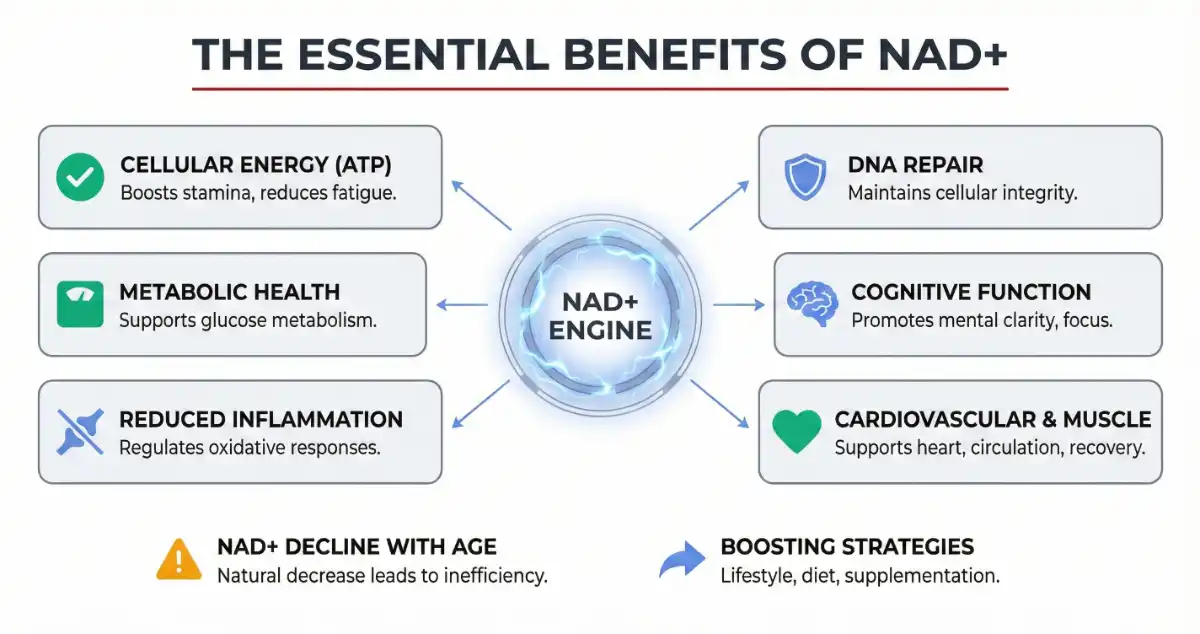
NAD+ is a coenzyme found in every living cell. It’s not optional biology—it’s fundamental. Without adequate NAD+, your cells cannot efficiently convert food into energy (ATP), repair damaged DNA, activate longevity proteins called sirtuins, maintain healthy mitochondrial function, or regulate cellular stress responses.
Think of NAD+ as your cellular battery. When it’s charged, everything runs smoothly. Energy production is efficient, DNA damage gets repaired quickly, inflammation stays controlled, and cognitive function remains sharp. When NAD+ depletes (which happens progressively with age), everything slows down. Mitochondria become dysfunctional, DNA damage accumulates, inflammation increases, and you feel it as fatigue, brain fog, poor recovery, and accelerated aging.
Here’s what makes NAD+ decline particularly insidious: it’s not a sudden drop. It’s gradual degradation over decades. You adapt to slightly lower energy levels year after year, attributing it to “getting older” rather than recognizing it as correctable cellular dysfunction. By the time you’re 50, you’re operating at half capacity compared to your 20s, and you’ve normalized it as inevitable aging.
But it’s not inevitable. NAD+ depletion is measurable, predictable, and—most importantly—reversible.
Why NAD+ Declines (And Why It Accelerates After 40)
Multiple factors drive NAD+ depletion. Aging itself is the primary driver. NAD+ synthesis decreases while consumption increases. The enzymes that produce NAD+ become less efficient, while the enzymes that consume it (CD38, PARPs) become more active. This creates a compounding deficit that accelerates over time.
Chronic stress is a major accelerant. Stress activates PARPs (poly ADP-ribose polymerases), enzymes that consume massive amounts of NAD+ for DNA repair. Constant stress means constant PARP activation, which rapidly depletes NAD+ stores. This is why people in high-stress careers often feel decades older than their chronological age.
Poor sleep prevents NAD+ regeneration. NAD+ levels follow circadian rhythms, rebuilding during quality sleep. Chronic sleep deprivation prevents this recovery, creating progressive depletion.
Metabolic dysfunction amplifies the problem. Obesity, insulin resistance, and inflammation all increase NAD+ consumption while reducing production. If your metabolic health is compromised, you’re burning through NAD+ faster than your body can produce it.
Excessive alcohol consumption destroys NAD+. Alcohol metabolism directly consumes NAD+, which is why heavy drinkers experience accelerated aging and why hangovers feel like cellular devastation—because that’s literally what’s happening.
Overtraining without adequate recovery depletes NAD+. Exercise is beneficial and transiently depletes NAD+ (which signals adaptive responses), but chronic overtraining without recovery prevents NAD+ restoration. This is one reason why overtraining produces fatigue, poor recovery, and declining performance despite increased effort.
The perfect storm hits around age 40-50: natural age-related decline accelerates, career stress peaks, sleep quality often deteriorates, metabolic health starts declining, and recovery capacity diminishes. NAD+ gets crushed from multiple directions simultaneously.
The Sirtuin Connection: Why NAD+ Matters for Longevity
NAD+ isn’t just about energy. It’s the required cofactor for sirtuins, a family of proteins that regulate cellular health, inflammation, stress resistance, DNA repair, and longevity. Sirtuins are the molecular mechanism behind caloric restriction’s lifespan-extending effects. When you restrict calories, NAD+ levels rise (because you’re consuming less energy), sirtuins activate, and longevity pathways engage.
Here’s the problem: most people aren’t willing to maintain 30% caloric restriction indefinitely to activate sirtuins. That’s where NAD+ supplementation becomes relevant. By directly increasing NAD+ availability, you can activate sirtuins without extreme caloric restriction.
Sirtuins regulate mitochondrial biogenesis (creating new, healthy mitochondria), DNA repair and epigenetic regulation, inflammation and immune function, cellular stress resistance, and metabolic efficiency. These aren’t minor effects. Sirtuins are master regulators of cellular health, and they’re NAD+-dependent. No NAD+, no sirtuin activation, no longevity benefits.
This is why NAD+ has become central to longevity research and why David Sinclair and other prominent aging researchers consider NAD+ restoration foundational for healthspan extension.
The Oral NAD+ Problem (Why Most Supplements Don’t Work)
Walk into any supplement store and you’ll find NAD+ precursors: NMN (nicotinamide mononucleotide), NR (nicotinamide riboside), niacin, and others. These compounds theoretically convert to NAD+ in your cells. The problem? Conversion efficiency is wildly variable between individuals, and for many people, it’s inadequate.
Oral NAD+ precursors must survive digestion, get absorbed, reach cells, and then undergo enzymatic conversion to active NAD+. Each step has efficiency losses. Some people convert NMN or NR effectively and feel dramatic improvements. Others take grams daily and feel nothing because their conversion machinery is inefficient or their consumption rate outpaces production.
You can’t take NAD+ itself orally—it’s broken down in the digestive system before reaching cells. This is why direct NAD+ administration (IV, injection, or nasal spray) has become the preferred approach for people serious about restoration. You’re providing NAD+ directly to cells without relying on uncertain conversion processes.
The oral precursor approach is: take 500-1000mg NMN daily, hope your body converts it efficiently, guess whether it’s working based on subjective feelings, and spend months wondering if you’re wasting money on expensive urine. The direct NAD+ approach is: administer NAD+ via injection or nasal spray, bypass conversion requirements entirely, achieve predictable NAD+ elevation, and notice effects within days to weeks.
For people pursuing optimization rather than hoping for results, direct administration makes sense.
NAD+ Injection vs. Nasal Spray: Which Delivery Method Works?
Both delivery methods bypass the digestive system and provide direct NAD+ to your bloodstream. The choice comes down to personal preference, lifestyle, and goals.
NAD+ injections (subcutaneous, self-administered at home) provide consistent, predictable absorption with reliable dosing and effects. You know exactly how much NAD+ you’re receiving. Most protocols use 2-3 injections weekly, typically 100-200mg per dose depending on individual needs. The injection itself is simple—similar to insulin injections diabetics self-administer. Absorption is steady and sustained.
The downside? Some people experience mild flushing or warmth during administration, which is benign but can be uncomfortable. Starting with lower doses and building up minimizes this effect. And obviously, it requires being comfortable with self-injection.
NAD+ nasal spray offers non-invasive administration with no needles required. Absorption through nasal mucosa is rapid and effective. It’s convenient for daily use or as-needed energy support before demanding cognitive or physical tasks. Dosing is flexible—you can adjust based on daily needs rather than committing to fixed injection schedules.
The downside? Absorption can vary slightly between administrations depending on nasal congestion, technique, and individual nasal physiology. And per-dose cost is often higher than injections for equivalent NAD+ delivery.
Many patients start with nasal spray to assess response before committing to injection protocols. Others prefer injections from the start for predictability and cost-effectiveness. Some use both—injections for baseline maintenance and nasal spray for acute performance demands.
What NAD+ Restoration Actually Feels Like
This isn’t caffeine. It’s not a pre-workout stimulant that hits hard and crashes. NAD+ effects are more subtle and fundamental—you’re restoring cellular energy production capacity rather than artificially stimulating it.
Most people notice energy improvements within 3-7 days of starting NAD+ therapy, particularly if baseline depletion was significant. It manifests as sustained energy throughout the day without afternoon crashes, improved physical stamina and endurance, better recovery from workouts or physical stress, and reduced need for caffeine to maintain alertness.
Cognitive improvements typically appear within 1-2 weeks. Enhanced mental clarity and reduced brain fog, improved focus and sustained attention, better processing speed and cognitive stamina, and increased motivation and mental energy. This isn’t stimulant-driven hyperactivity. It’s your brain functioning at the capacity it should when cellular energy production is optimal.
Recovery benefits develop over 2-4 weeks of consistent use. Faster recovery between training sessions, reduced soreness and inflammatory response, improved sleep quality (better cellular repair during sleep), and enhanced ability to handle physical and mental stress.
The longevity benefits are occurring immediately at the cellular level—DNA repair, mitochondrial optimization, sirtuin activation, reduced oxidative stress—but these manifest as measurable health improvements over months to years of sustained use. You can track inflammatory markers, metabolic health, and other biomarkers to see objective improvements even if subjective effects are subtle.
Who Actually Needs NAD+ Restoration?
The short answer: almost everyone over 35-40 would benefit to some degree, since NAD+ decline is universal with aging. But NAD+ therapy makes the most sense for specific groups.
High performers experiencing unexplained fatigue despite optimized sleep, diet, and lifestyle. If you’re doing everything right but still feel suboptimal, NAD+ depletion is often the missing variable.
People in high-stress careers where chronic stress is depleting NAD+ faster than it can regenerate. If you’re operating at peak stress levels consistently, you’re burning through NAD+ and need restoration to maintain performance.
Athletes and active individuals demanding peak recovery. Intense training depletes NAD+. Restoring it accelerates recovery and maintains performance capacity.
Anyone over 40 pursuing longevity optimization. NAD+ restoration is one of the most evidence-supported longevity interventions available. If you’re serious about healthspan extension, NAD+ should be in the conversation.
People with metabolic dysfunction. Insulin resistance, prediabetes, obesity, and metabolic syndrome both deplete NAD+ and benefit from its restoration. NAD+ improves insulin sensitivity and metabolic function.
Individuals experiencing age-related cognitive decline. NAD+ supports brain energy metabolism and neuroprotection. Restoration can preserve cognitive function and potentially slow decline.
NAD+ and Comprehensive Longevity Protocols
NAD+ is rarely used in isolation by people serious about optimization. It’s typically part of a comprehensive longevity stack targeting multiple aging pathways simultaneously.
The classic longevity triad combines NAD+ for sirtuin activation and cellular energy, rapamycin for mTOR inhibition and autophagy, and metformin for AMPK activation and metabolic optimization. These three compounds target complementary pathways—together they address the primary molecular mechanisms of aging more comprehensively than any single intervention.
Other synergistic compounds include sermorelin for growth hormone optimization, methylene blue for mitochondrial support, glutathione for antioxidant capacity, and various peptides depending on specific goals.
Lifestyle optimization remains foundational. NAD+ amplifies the effects of resistance training (maintains muscle mass and metabolic health), quality sleep (allows NAD+ regeneration and cellular repair), stress management (reduces NAD+ consumption), and nutrient-dense diet (provides precursors for NAD+ synthesis).
Comprehensive bloodwork provides objective tracking. Fasting glucose, insulin, and A1c for metabolic health, inflammatory markers like hs-CRP, liver and kidney function to ensure safe supplementation, and lipid panels and cardiovascular markers. You can’t optimize what you don’t measure, and NAD+ effects are best assessed through objective biomarkers alongside subjective improvements.
The Cost-Benefit Analysis (Is NAD+ Worth It?)
NAD+ therapy starts around $150/month depending on dosing protocol and delivery method. That’s not trivial, but context matters.
Compare that to the cost of chronic fatigue: reduced productivity, cognitive underperformance, poor decision-making under brain fog, decreased quality of life, and medical costs from preventable age-related decline. If NAD+ restoration improves cognitive performance by even 10%, the ROI for high performers is enormous. If it extends healthspan by preventing metabolic dysfunction or supporting longevity pathways, the value compounds over decades.
NAD+ has extensive safety data (as NAD+ itself is endogenous to your body), is well-tolerated with minimal side effects for most people, has effects that are noticeable within days to weeks (unlike many longevity interventions), and provides both immediate performance benefits and long-term healthspan support.
The alternative is accepting progressive NAD+ decline as “normal aging”—watching energy decrease, recovery slow, cognition decline, and metabolic health deteriorate while doing nothing because “that’s what happens with age.”
High performers reject that narrative. They test, identify deficiencies, and address them aggressively. NAD+ restoration is one of the most direct interventions available for reversing measurable cellular decline.
The Bottom Line on NAD+
NAD+ depletion is one of the most fundamental aspects of aging. By age 40-50, you’re operating at significantly reduced cellular energy capacity compared to your younger self. This manifests as fatigue, cognitive decline, poor recovery, and accelerated aging.
Unlike many aspects of aging, NAD+ depletion is directly addressable. Restoring NAD+ through injection or nasal spray administration bypasses the limitations of oral precursors and provides predictable cellular energy restoration.
This isn’t about masking symptoms with stimulants. It’s about restoring the cellular energy production capacity that enables everything else—physical performance, cognitive function, recovery, and longevity optimization.
Your cells need NAD+ to function. Age progressively depletes it. Restoration is straightforward for those willing to address it.
Stop accepting fatigue, brain fog, and declining performance as inevitable consequences of aging. Test your metabolic health, understand your baseline, and make informed decisions about whether NAD+ restoration fits your optimization strategy.
Schedule a free consultation to discuss whether NAD+ is appropriate for your goals, or start with comprehensive bloodwork ($189) to establish your metabolic baseline and identify optimization opportunities.
Medical Disclaimer: This information is for educational purposes and does not constitute medical advice. NAD+ therapy requires evaluation by qualified healthcare providers and is not appropriate for everyone. Never make treatment decisions based solely on internet information. Always consult licensed medical professionals for diagnosis and treatment.